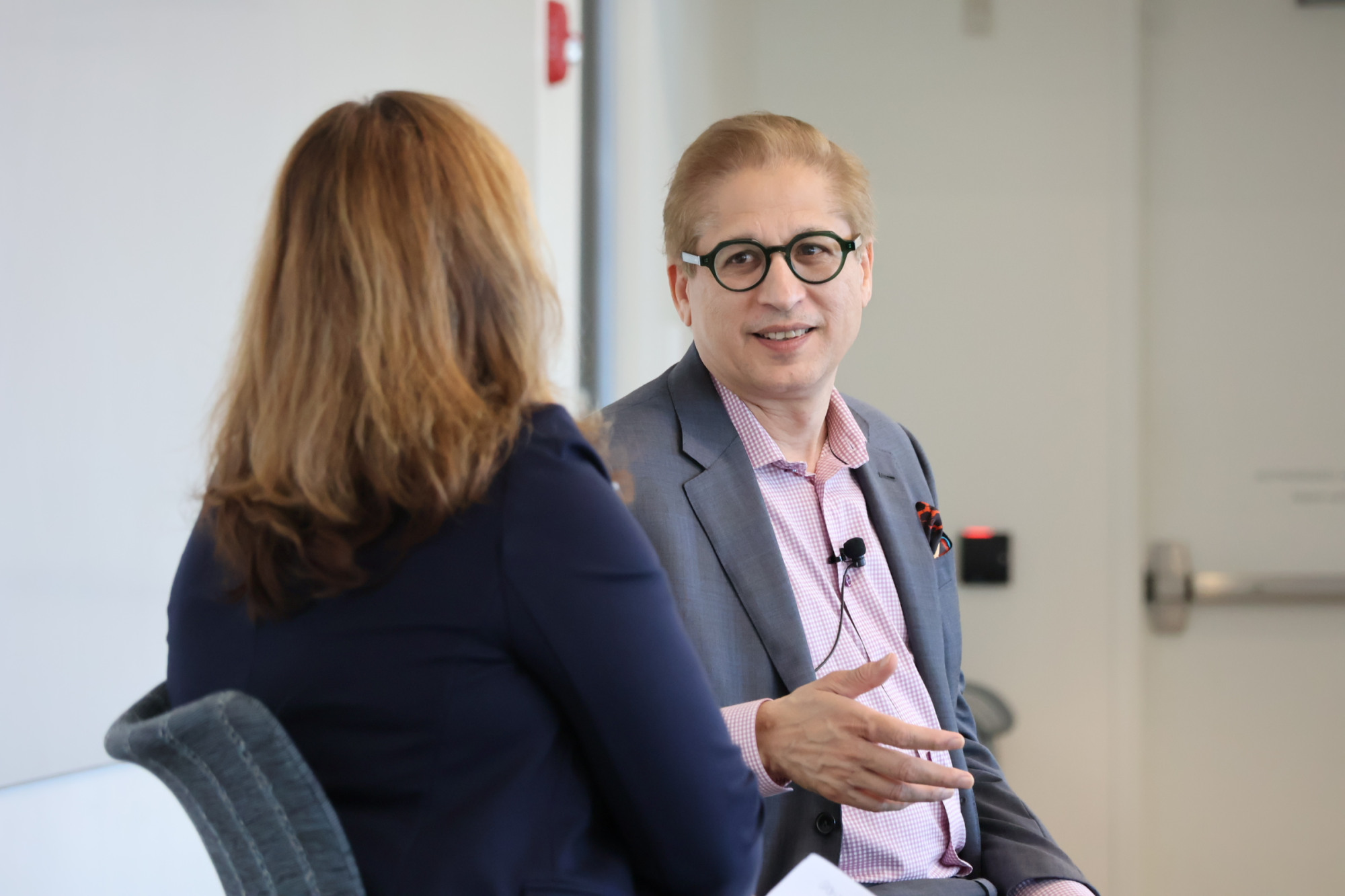
Q&A WITH FAHIM
Define your experience in the IE Brown Executive MBA in one word.
Metamorphosis.
What is the most important thing you bring to the table when you enroll into a program like the IE Brown Executive MBA?
Your experience, your convictions, your success and your failures.
What was networking like during the program?
Networking was at many different levels. One of them was indeed your cohort, which becomes more like a family. Then, there’s the faculty, and the interaction with the faculty is not only in the context of your course, there’s also a level of mentorship and mutual learning. And then, the alumni meetings both at Brown and IE. We meet people who are already successful, and the experience was great because they really connect you with the community, and it becomes something that lasts forever.
In what ways do you think your experience during the master’s program changed your life, professionally and personally?
Professionally, it was truly transformative for me. At the time, I was leading the technology department for a software company that had recently gone public. The MBA gave me the tools to have the wider context around the content I was dealing with, as well as specific knowledge about business, which, being a technical person, I did not have. The experience became an important foundation as I went on to lead technology organizations at scale and oversee teams of thousands of technologists. So, it has been a truly transformative experience for me.
As a person, a thing that I know now is that art and science are on the same continuum. That's not something that I understood before. The courses we took in art and politics, the courses we took in contextualizing the liberal arts with technology and business, really had me start thinking differently. So today, for instance, I sit on the board of Atlanta Symphony Orchestra, and I co-founded their Diversity, Equity and Inclusion Council.
Diversity and Innovation are two values defining the IE and Brown University ethos. They’re also two values you championed as a business leader at The Home Depot. How did your experience during the master’s program shape your professional perspective, especially thinking about these two values?
First, coming together with the IE Brown class, which came from many nationalities from all over the world, and then learning in the context of a European university as IE. It really opened my perspective. Even though I grew up in Pakistan, I only went to university in the United States, and all my professional career to that point was in the United States. Having this context of a much global cohort, every time you addressed an issue, an assignment or had a discussion, you had input from people from all these different nationalities, and different points of view. And you really start seeing how diversity contributes to stronger solutions that really have a global context in mind.
I also learned that innovation is not just about technology. Framing the questions that you are trying to respond to is very important for innovation to happen. I learned to ask better questions thanks to the MBA. Better questions always lead to better answers.
What skills did you gain during your studies that have been instrumental for your professional success?
One important skill that I gained is to have a humanist view towards problems and challenges that you face. Having a view of the community that you're interacting with, and the community around us. And by community I’m not just talking about the stakeholders or the stockholders; it’s also the underrepresented around us. We must take into consideration the people who may not have a voice; and giving them a voice becomes an important issue. And I learned that you have to seek out the constituents. Not everybody is going to speak up, be it in a meeting, be it in the context of a global discussion. You have to identify the people who might be affected by your decisions, and you need to know that their point of view is important. They should be given the opportunity to speak and contribute to come up with the best outcomes.
How do you apply new technologies and the entrepreneurial mindset in such a large corporation considering the fast-changing technological environment?
I think larger companies actually have to work harder and faster to keep up with change, and change is required every day. The executive team spends 80% of their time and interaction dealing with strategic issues that affect change. Technology has become what we call the "long pole in the tent", meaning that if you don't have technology enabling a certain initiative, that initiative is likely not happening at our scale of business. Organizations like The Home Depot, one of North America's largest home improvement retailers, must continue investing in change.
As I mentioned before, there are thousands of technologists engaged in building technology. A majority of the budget that is spent on human resources goes towards innovation and building new capabilities. This is a strategic decision made to ensure that we remain ahead of the customers' needs, and ahead of the competitors, of course. But the focus is customers back: first, to understand what it is that the customers need, and what it is that the associates need, and then to make the investment in technology.
Being large is actually an advantage, because you have sufficient resources available to make the changes that are important. But they’re also very thoughtful about innovation. To introduce any change, we might start not even writing the code, but trying something on paper, and try it out in a single store. Then we might write code and try it in five stores, and then 10, and then 50, and then test and learn. At times, we actually write the code and learn that it wasn't exactly what we wanted. So, we are a fully agile shop, meaning we release code within days, and that means the change cycle is very rapid.
In the podcast episode “Inspired Execution” with Chet Kapoor you talked about how at The Home Depot you are trying to integrate machine learning into the customer experience. Could you elaborate on that?
A really good example of how we have incorporated machine learning into the customer experiences is what we do with machine vision in our stores. The typical Home Depot store is about 100,000 square feet. There are goods on the shelves, and there's also additional stock in the overhead. You don't always know when somebody has taken the last item from a shelf out, so at any given moment you might have an empty space in the shelf, you will find nothing there. And when the next customer shows up looking for that product it might be a disappointing moment for them. So, we have incorporated machine vision. We are continually taking videos or pictures of our shelves and the overhead space, and that helps us to specifically direct our associates to go find any item in any specific overhead, bring it down, and restock it. We can do this in near real time because each of our associates has a handheld Zebra device, that's an Android device for communication. So, we can actually do this process that we call "direct pack down", incorporating machine learning, and specifically machine vision into it.
Another example of that is the machine learning application that we have incorporated into our search and recommendations engine. If you have our app, you can use it to take a picture of something that you may want to buy, and we will match the product in the picture with what we have in our catalogue and show you everything that most closely matches what you're looking for.
How have you stayed connected with the IE Brown community, and how have these connections benefited your career?
I have stayed connected both with the IE and Brown communities over the last several years. I've come into speaking arrangements as well as mentorship. And, more importantly, I've become a reference for folks who want to join this program, because most of the time, people in the United States don't recognize what a wonderful university IE is. Providing that bridge back from the US to IE has become an important thing for me.

You have long been committed to giving back through mentorship, philanthropy and community leadership. Why is that important to you?
I think generosity is an important attribute, paying it forward matters. And you don't just necessarily give back in money; you can give back with your time, your attention and your mentorship. Certainly, providing a certain amount of money and having a brick or a plaque with your name on it, is inspirational for people. It becomes a visible representation of your commitment. But just as important is the time you give to the community, the time you give to nonprofit and the time you spend on mentorship and helping others grow. That's how you pass on a legacy, and that's how you ensure that the legacy continues.
What’s your measure of success?
My measure of success is the amount of success opportunities that you have created for people around you.
What can we do within our IE Brown community to create an impact and support education?
I think we can continue to invest more in underserved communities globally and help create that space for them to get to this wonderful institution of education.
If you had a billboard that you could display to the world, what would you write on it?
Serve with distinction. Live with empathy.